


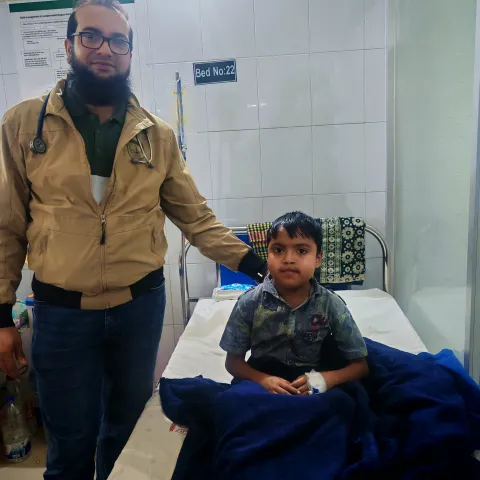
Raj Dip, Bangladesh shared by Abu Yousuf
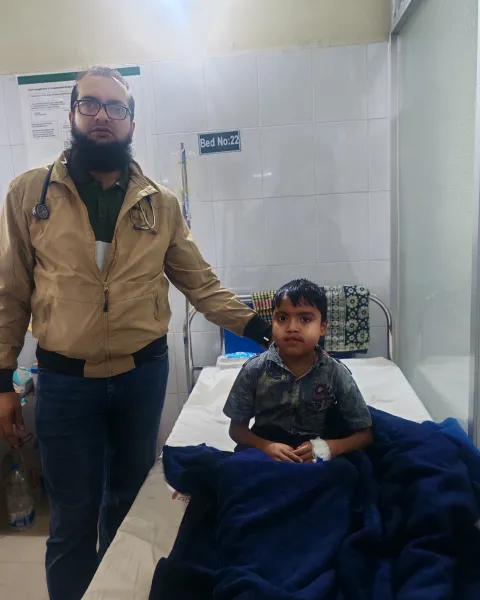
Story: Raj Dip’s Quiet Fight
Raj Dip was only ten years old, a thin boy with bright eyes and a soft voice. He loved drawing cricket players and dreamt of becoming a fast bowler one day. His world was small—his school, a narrow lane in the neighborhood, and the tiny restaurant where his father worked long hours every day.
His father, a simple restaurant worker, earned just enough to keep the family going. There was never much, but there was always love, and that was enough for Raj Dip.
Then the fever began.
At first, it looked like an ordinary infection. The local doctor gave medicines. But the fever did not go away. Soon, his neck started swelling with enlarged lymph nodes. Then came the bleeding from gums and nose. His parents were frightened, but they had no idea what was really happening inside their child’s body.
He was taken to a local hospital. There, without a confirmed diagnosis, steroids were given to control the symptoms. For a short time, Raj Dip seemed to improve. The swelling reduced, and the fever settled. Everyone felt relieved.
But the relief was temporary.
When Raj Dip was finally brought to our center, we suspected something more serious. The symptoms, the blood counts, the history—they all pointed toward a possible leukemia. But the steroids he had received earlier had masked the disease. The blasts had disappeared from the peripheral blood, making the diagnosis unclear.
We had to wait.
Those two weeks without any drugs felt like an eternity for the family. Every day his father would come to the ward, eyes filled with silent fear, asking only one question:
“Doctor, will my son be okay?”
Finally, the bone marrow test was done. The results came back.
Pre-B Acute Lymphoblastic Leukemia.
The diagnosis was confirmed.
But diagnosis was only the beginning. Treatment was expensive. The father, a restaurant worker, simply could not afford it. The numbers were beyond his imagination.
That was the moment when humanity stepped in.
My family, friends, and colleagues came together. Contributions were collected quietly, without publicity or noise. Piece by piece, the money was arranged. The initial tests were completed. The chemotherapy was started.
Raj Dip began his treatment journey.
The first weeks were hard. There were days with nausea, days with weakness, and days when he just wanted to go home. But slowly, his body began to respond. The fever disappeared. The lymph nodes shrank. His blood counts improved.
Then one day, during a follow-up visit, he showed me a drawing.
It was a picture of a cricket field. A small boy in the middle was bowling.
“Doctor uncle,” he said softly, “this is me. I will play again when I get better.”
Today, Raj Dip is on treatment and responding well. His journey is not over yet, but the direction is hopeful. His father still works long hours in the restaurant, but now there is something stronger than fear in his eyes—hope.
Sometimes, medicine is not just about drugs and protocols. Sometimes it is about standing beside a family when they have nowhere else to go.
And sometimes, that is what saves a child’s life.
1. What brought you to work in cancer care or support?
I chose haematology and cancer care because it is one of the few fields where science and humanity meet so closely. Many blood cancers, especially in children, are highly curable if diagnosed early and treated properly. That means every correct decision can literally save a life.
What motivates me most is the transformation I see in patients—children who arrive weak, pale, and frightened, and then slowly return to school, to play, to life. That journey is deeply meaningful.
2. What challenges do you face in providing people-centred care?
The biggest challenge is financial hardship. Many families cannot afford even the basic diagnostic tests, let alone months of chemotherapy.
Other challenges include:
Late diagnosis due to lack of awareness
Irrational or unregulated treatments before referral
Emotional stress on families
Limited healthcare infrastructure in certain regions
Balancing medical decisions with social realities is often the hardest part of the job.
3. What helps you deliver effective people-centred care?
Several factors make it possible:
Support from colleagues, friends, and well-wishers who help raise funds
A dedicated healthcare team that treats patients with empathy
Clear communication with families about the disease and treatment plan
Building trust with patients and caregivers
People-centred care is not done by a single doctor. It is a collective effort.
4. How do you see the healthcare system supporting or limiting people-centred care?
The healthcare system has both strengths and limitations.
What works well:
Availability of standard chemotherapy protocols
Increasing awareness about childhood cancers
Growing number of trained specialists
Where the gaps exist:
Limited financial support for poor families
Lack of structured referral systems
Inconsistent diagnostic facilities in peripheral areas
Absence of comprehensive social support programs
These gaps often delay diagnosis and interrupt treatment.
5. What lessons, insights, or messages would you share about people-centred care?
A few key lessons stand out:
Early and accurate diagnosis saves lives.
Financial support systems are as important as medical treatment.
Communication with families must be honest, simple, and compassionate.
Every patient deserves dignity, regardless of their financial status.
Advice for the healthcare system and professionals:
Build strong social support networks for cancer patients.
Ensure rational use of medicines before diagnosis.
Invest in early detection programs.
Treat not just the disease, but the person and the family around them.