


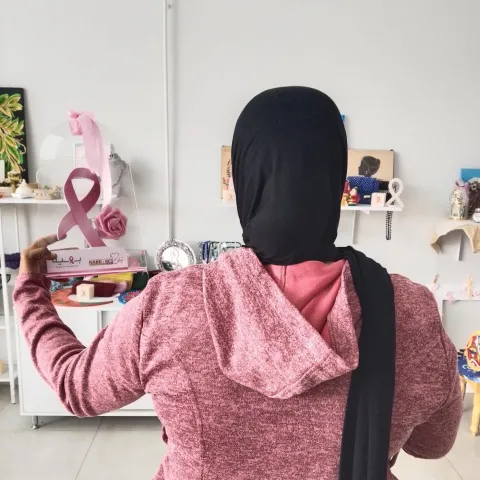
Amal, Egypt
My name is Amal. I am single and 26 years old. One day, while I was showering, I bumped my hand against my left breast and felt a lump.
I was terrified and decided to get an examination to find out what it was. I had the necessary scans and a biopsy. The results came back 10 days later, confirming that I had breast cancer. When I heard the news, it felt like the world went dark. I am still single, not yet married, in the prime of my youth. It felt like too much for me to handle such news at such a young age. I felt a horrific fear, like it was the end of the world.
I am from a rural area where there is no awareness of this disease; consequently, for us, cancer means certain death. In that moment, I felt like my body could no longer carry me and that no part of me was whole anymore.
There have been long-standing problems between my father and me; we barely interact even though we live together. I was dreading having to tell him I was sick, but I had to inform both him and my mother. When I got home and told him, his response was that it wasn't his concern and that he didn't have money to treat anyone. My mother, however, said she was willing to sell the very clothes on her back to get me treated. My father constantly told me not to tell anyone about my illness; he wanted me to hide every prescription, scan, or test result so no one visiting our home would find out. To him, this disease was a stigma, a source of shame that shouldn't happen to a young, unmarried girl. People in rural areas often cannot grasp that this illness can affect anyone; they think it only happens to older, married women. To them, it’s a disgrace they need to get rid of, and my father was one of them.
After the third chemotherapy session, I looked at myself in the mirror. My hair was gone, and my face was pale. You can imagine the psychological impact that had on me.
During that period, my closest friends were afraid and distanced themselves; none of them stood by me, except for one single friend who stayed.
My mother was my greatest support during that time—I could say my only support. My father, meanwhile, fought with me constantly, showing no consideration for my illness until I eventually developed diabetes as well. I wanted to take my mother and leave the house just to escape that nervous pressure. The combination of chemotherapy and diabetes exhausted me beyond belief; I felt like I was dying. I sat my father down and asked him to promise to take care of my mother and not abandon her if I died, because I was the one working and supporting her, as my father had abandoned his responsibilities toward us since I was 13.
Over time, my father improved. He began trying to get closer to us and look after us, but only after seeing that I was at death's door.
After the biopsy analysis, the tumor was found to be Triple-Negative and active. The doctors told me I had to undergo chemotherapy again. This was a massive shock because I was desperately waiting for my hair to grow back.
During my treatment, I found a second family at the hospital among the fellow fighters and the support team. They stood by me and never left my side. In that place, I felt a sense of humanity—I felt that they treat the patient, not just the disease.