



DEBORAH JANE, Israel
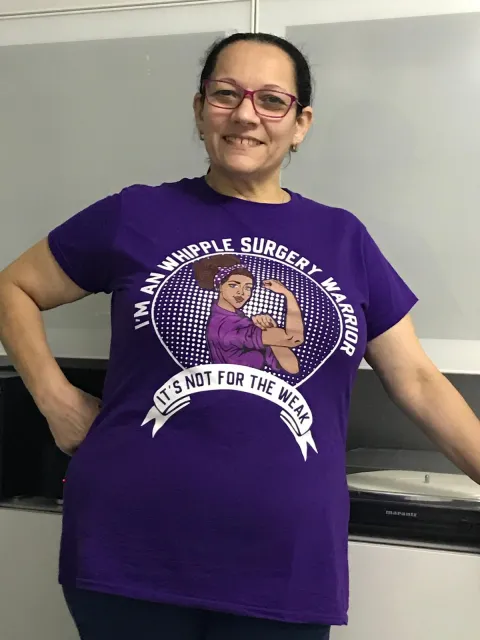
*"They gave me two months to live and today I'm here"*
Next week will mark World Cancer Awareness Day, a day dedicated to awareness, support and inspiration for millions of people dealing with the disease around the world. The story of Deborah Jane Menachem, a 58-year-old resident of Bat Yam, is a rare case of survival from pancreatic cancer, a disease that in most cases is considered one of the most difficult to cure.
*"It was one of the hardest moments in my life, but something in me said I wasn't ready to give up"*
"I immigrated to Israel alone from London about 40 years ago. I immigrated because I love the country very much, and it's also too cold in London. "I love the weather in Israel," says Deborah. At the time, Deborah was working as a seamstress, but about a decade ago, her life was shaken when she was diagnosed with pancreatic cancer.
"I arrived at the emergency room at Wolfson Hospital with obstructive jaundice and a resistant and aggressive bacteria. I had to undergo surgery, and as part of the preparation I was asked to undergo an MRI scan. The scan showed that I had a large shadow in the pancreas area, but I was optimistic, I thought it was a cyst," she recalls. Dr. Katia Dayan, a surgical director at Wolfson who accompanied her throughout the entire process and still keeps in touch with her today, broke the news to her personally: "She sat next to me, held my hand tightly and told me that I had pancreatic cancer. It was one of the hardest moments of my life, I was surprised and shocked."
*What do the numbers say about pancreatic cancer?*
"Pancreatic cancer is considered one of the most aggressive cancers in terms of survival. Worldwide, the survival rate after a year from diagnosis is only around 28%, and the survival rate after five years is less than 8%-10%. This is mainly because the cancer is sometimes diagnosed only in advanced stages, when it has already spread to other organs and treatment options are greatly reduced," explains Dr. Ronen Brenner, Director of the Oncology Institute at the Wolfson Medical Center.
*"You have two months to live"*
When I arrived at the health insurance company where I was treated, the doctor looked at me and said: "You have two months to live. Start sorting out your forms and affairs." I was shocked. Despite this, I did not give up, I wanted to live. I told myself that I had to be a grandmother, to see my children bring grandchildren into the world. And at that moment the chip fell on me - I did not get the cancer, but the cancer got me. I am the owner of the house!"
Dvora went to war for her life. She began a journey of treatments at the Oncology Institute at the Wolfson Medical Center under the direction of Dr. Ronen Brenner. The institute treats a variety of types of cancer with a multidisciplinary approach. Among the treatments provided at the institute: chemotherapy, biological treatments, supportive care, multidisciplinary consultation sessions (Tumor Boards) and more. "When it comes to cancer, it is important not only to provide clinical treatment but also to build a support system that includes the entire patient: professionalism, availability, listening and humanity. When Dvora came to us, we knew that we had the knowledge and tools to give her the best chance. But more than that - it is important to give her hope, if only so that she can fight." Dr. Ronen Brenner, Director of the Oncology Institute, explains.
During the treatment, Deborah underwent frequent chemotherapy treatments and 28 radiation treatments. She says that the dedicated care she received at the institute was a major factor in her success: "It's kitschy to say, but the team of nurses and doctors are my angels. The nurses are the backbone of the department, they surrounded me with a warm and humane attitude all the way."
Debora emphasizes the family support she had throughout: "My husband and children never left me for a moment. They were there at every stage, and they gave me the strength to continue."
In addition, during the treatment period, Deborah also participated in medical meditation workshops held at the institute: "I learned that the mind controls the body. The more positive I was, the better my body responded. I learned to control my emotions and reduce stress."
Today, more than a decade has passed since the disease and Deborah, who defeated cancer, comes to the oncology institute to encourage other patients and share her hope and experience with them: "I always tell them - you did not get the cancer, the cancer got you and you will fight. Stay positive, and believe that there is hope even in difficult situations."
Dr. Ronen Brenner, Director of the Oncology Institute, concludes: "Debora's success is a combination of extraordinary willpower, advanced treatment and human support. Every patient at our institute receives personal attention and this is what allows a medical miracle to happen, even in cases that seem hopeless."
*On World Cancer Awareness Day, which is celebrated next week, Deborah's story reminds us all of the importance of hope, the power of professional and dedicated care, and the great impact of human support on coping with the disease.*