


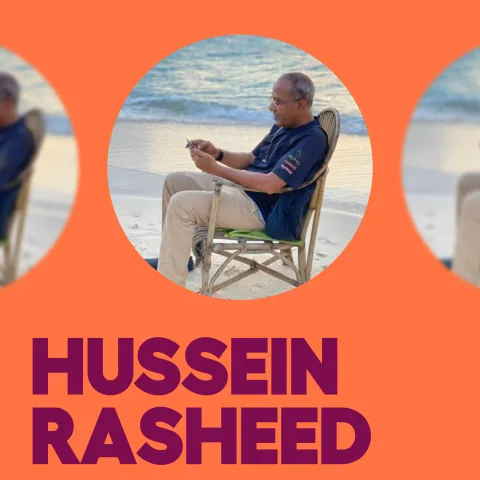
Hussain, Maldives
The journey began in March 2003 when I experienced a day of severe pain. That was the most excruciating pain in my life. I am aware that pain is an indication and symptom of an underlying medical issue. I had no inkling of what this pain was telling me or letting me know. However for some reason, at that particular moment, I thought to myself that, Insha'Allah this would not be cancer. Up to today, I still have no clue as to why I thought so. I believe such thoughts came to my mind in the holy city of Makah in front of the "Kaaba" with the Mercy of Allah SWT, for me to be given the opportunity to drink zamzam water, which we believe has healing power. Unknowingly I was given the opportunity of healing here too.
After returning to Male', immediately I met Dr. Firdous, at his house at night, and explained my health condition. He said he was leaving for Singapore the next night and for me to come early in the morning to meet him at the Indira Gandhi Memorial Hospital.
After examining and conducting numerous blood tests, and performing an endoscopy Dr. Firdous said I needed a biopsy and he had taken a sample but the results would take some time. I noticed and remember the concern and the doctor's demeanor and his teary eyes to this day. The doctor did not mention what was the problem, only to take the referral he had given to me and said to go to Cochin and to hand this document to the doctor he recommended. I was scheduled to go to Bangalore on a 2 day official visit. There I met a former student and his parents who recommended me to go to Manipal and to meet a specialist doctor known to them. I was in the dark and did not know what was going on. I travelled to Manipal for further investigations as recommended by them.
Following further endoscopy and biopsy results, I received the devastating diagnosis and realized the severity of my condition. I was informed that I needed immediate abdominal/intestinal surgery. This was the start of the journey of the rest of my life.
Panic, shock and dismay were my initial feelings. The enormity and the weight of the diagnosis felt to me, as if I was plunging into a dark abyss, with me in freefall and no cushion to protect me from this danger. Surgery took a heavy physical and mental toll on me: - partial removal of my stomach, my intestines and my gall bladder - I realized that this was actually the 'easy part'- and that the 'true battle' started a month later with the toxic poison of chemotherapy and the grilling by radiation I struggled with severe exhaustion, deep loneliness and a sense of being disconnected from the world, which led me to question even the meaning of life..
Faith and Spirituality: I found strength in trusting Allah's Mercy and absolute faith that His Plan is the best and that I would not be tested with a burden I could not bear. I surrendered to my destiny, believing that whatever was written for me was meant for me to endure.
Guidance: I maintained complete trust in the wisdom and care of my doctors and health care team throughout the diagnosis, treatment, recovery and follow ups.
A Shift in Perspective: Choosing to fuel my journey with courage and determination rather than fear allowed me to see the experience as a "second chance" for transformation and a better me.
About twenty-three years ago, the Maldivian healthcare system was deeply rooted in compassion, empathy, and an unwavering commitment to caring for people. However, despite this strong moral foundation, the country lacked the clinical capacity to treat cancer. At the time, there were no established pathways for chemotherapy or advanced oncology care within the national health system. Families faced limited choices, and the possibility of receiving cancer treatment in the Maldives seemed almost unimaginable.
It was during this period that a quiet but pivotal moment emerged, one that would mark the beginning of cancer chemotherapy in the country.
After seeking specialist advice from Manipal Hospital in India, a critical question was raised: Could any part of the treatment be continued while the patient remained in the Maldives? This inquiry led to a series of telephone consultations with Dr. Mohamed Firdous, Head of the Department of Surgery at Indira Gandhi Memorial Hospital (IGMH). His willingness to explore untested possibilities, despite the absence of local systems or prior experience, became the catalyst for change.
Following these discussions, a shared decision was reached whereby chemotherapy would be initiated abroad and continued upon the patient's return to the Maldives. Treatment commenced in India, and shortly thereafter, I was treated as an out-patient in IGMH to receive the remaining doses. What followed was unprecedented. Chemotherapy had never been administered in the Maldives, and the hospital had no established oncology unit, no standardized protocols, or formally trained chemotherapy nurses.
Fully aware of the responsibility and risk involved, Dr. Firdous approached the task with exceptional care and diligence. He maintained close consultation with the oncology specialist, who was the primary physician in India, verifying each step of the process to ensure patient safety. Two experienced nurses from the surgical ward- trusted professionals- were carefully selected and personally guided through the unfamiliar and demanding process of chemotherapy administration. In the absence of formal training programs or psychological support systems, these nurses carried not only the technical responsibility of a new clinical practice but also the profound emotional burden of caring for a patient undergoing an unfamiliar and intimidating treatment.
Numerous operational challenges were also faced. At the time, the hospital did not have standardized documentation tools, and even basic systems such as oncology medication charts were unavailable. To ensure accurate documentation and minimize the risk of medication errors, the chemotherapy medication chart was hand-drawn and meticulously maintained, reflecting an early commitment to medication safety in the absence of formal systems.
Flexibility was also extended to accommodate the patient's needs. Recognizing the significant impact of treatment on daily life, arrangements were made for chemotherapy to be administered after regular office hours. This consideration eased the patient's burden and exemplified a compassionate, patient-centered approach at a time when formal protocols and structured services had yet to be established.
Against these odds, the treatment proceeded safely and successfully. Within the walls of a single hospital ward, supported by a small but determined team, the Maldives took its first steps into cancer chemotherapy. What began as an individual patient's journey driven by necessity, courage, and collaboration quietly opened a pathway for the development of cancer care in the
country.
The medical professionals who treated me were all competent, compassionate and I got excellent care and guidance both at the initial testing phase as well as during recovery. I would like to credit the successful outcome of my five-year battle with cancer to a combination of Divine Mercy and the expertise of my healthcare providers in both Manipal Hospital and Maldives.
Prioritize Self-Care: It is vital to take care of yourself, both physically and mentally.
Nurture Relationships: Strengthen the bonds with those
around you and never take people for granted.
Practice Gratitude and Forgiveness: Embrace even the smallest acts of kindness with gratitude and learn the power of forgiving others.
Support Others: I would like to stress on the value of including others in our prayers and sharing our story to provide a "light" for those walking a similar dark paths.
Ask and Seek help from loved ones.