


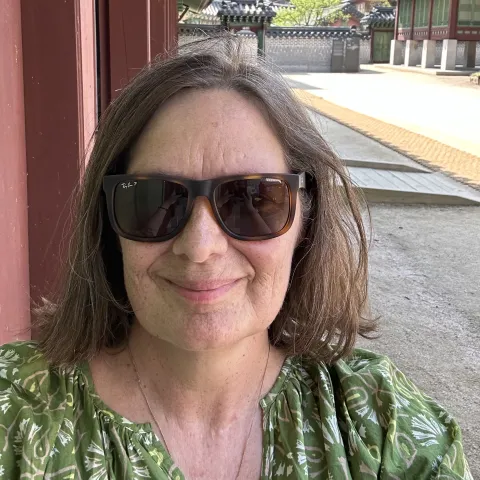
Jo, United Kingdom
I am Jo Grey and I am based in UK. I have a genetic neuroendocrine tumour condition called multiple endocrine neoplasia type 2A.
How were you diagnosed and how long did it take?
I was the first person in my family to be diagnosed with MEN2A. The route to diagnosis was quite a long and painful one and took a total of about 4 years. My first main symptoms occurred after the birth of my daughter, who was born in 1996. I had a lot of headaches, palpitations, I felt very weak. I described the headaches to my GP as migraine attacks because they were very sudden and very severe. I was quite up and down for a few weeks. Then things started to settle again.
The same thing happened again just before my son was born in 1999. He came a month early because I started suffering these attacks. They did not have the headaches at that point but I still had the palpitations, the breathlessness. I felt very weak; I couldn’t lift my baby up. I kept going back to my family doctor. They did some blood tests and they said “we can’t see anything wrong”. I had some tests on my heart and I was told to stay away from doctors for a while because I was becoming anxious with all this medicalisation. The attacks dissipated again after a few weeks. I tried to carry on as normal although I never felt right. I was always fatigued and by the time my son was nine months old, I suddenly became very ill again. I had more of these migraine attacks but they were much worse now and included vomiting. I couldn’t eat, I always felt hot, I couldn’t take hot showers. Going back to my family doctor, he diagnosed me as postnatally depressed, which I flatly disagreed with. In the end, I was so ill, I could not argue with anyone anymore. In fact, I decided that life was no longer worth living and that it was probably better if was not there anymore.
At that point I was taken to a private psychiatric hospital near my home. I had been on so many drugs – sleeping drugs, blood pressure drugs, all kinds of weird drugs that were making me even worse. When I got into this hospital, I was taken off all the drugs that I was put on my family doctor and my head started to clear a little bit. I spent a month at this psychiatric hospital altogether and during that time my blood pressure was taken every time I had a migraine attack and they noticed that my blood pressure was extremely high in these moments. There was a doctor, a consultant clinician, who came with a couple of big plastic bottles and said “I want you to collect your urine in those”. After they made the tests, he came back and said “I have been looking for this tumour in psychiatric patients for 20 years and you are the first one that I found”. It is a neuroendocrine tumour called a phaeochromocytoma and it is functioning, so a secreting tumour of the adrenal gland. At that point I felt sort of released from the doom and gloom. Because I had a diagnosis of something tangible.
What treatment have you had and how did it affect you then and now?
After the scan I was transferred to a large university hospital where I had my surgery. And then I went for genetic testing, which at that time took 6 months for the results to come out. I also had more blood tests that showed I had another neuroendocrine cancer called medullary thyroid cancer. So, I had more surgery. I had my thyroid removed. Then the genetic test came out saying I have multiple endocrine neoplasia type 2A. The genetic testing was cascaded down through my family and it was found that my mother had the same condition, although it had never been picked up and she never had the same symptoms as me. My son was also found to have the condition as well.
So once all the treatments had happened, life settled back down again. I could be the mother I wanted to be, to care for my children. Which was something that was denied to me for too long, for four years.
Then I noticed a pain in my shoulder and was diagnosed metastasis from my medullary thyroid cancer in the top of my left humerus. I had a shoulder replacement on that side, which took two years to recover from and regain any sort of movement. And from then on it was six-months-screening, surveillance, adjusting drugs and so on. And I’ve had a good 20 years of good health.
What impact has the diagnosis had on your personal life?
The hardest throughout was not being listened to by my GP who ran just normal tests and made an assumption – because I was a woman who had a baby – that it must be psychological. And unfortunately, I think there is still a lot of that around, this medical misogyny. The other most difficult thing was watching my son going through surgery at three years old. I understood the benefit was, for him, because his diagnosis came at age two and a half, they will be catching anything earlier and he will not have to go through the pain I went through.
What lessons have you learnt along the way?
One of my messages is that I really encourage doctors in primary care and even secondary care as well: if you’ve got a returning patient, if they are returning time and again, never to assume that it is just anxiety, or psychiatric, or emotional problem.
There is a new rule in general practice in UK called the Jess’s Rule, which says that anyone who returns to their GP (with the same symptoms) more than three times, really needs to have further workup and really try to understand if there is something wrong before it is too late. And this is the only way that we will catch any of these weird, rare diseases, tumours – there are so many things it could be. So, we really need to spread this message far and wide and to try and aid earlier diagnosis of these neuroendocrine cancers and any other condition.
Jo is the CEO of AMEND (incorporating Phaeo Para Support UK): https://www.amend.org.uk/
This story was published with Jo's consent. A video can be watched on International Neuroendocrine Cancer Alliance website: https://incalliance.org/stories/jo-uk/