


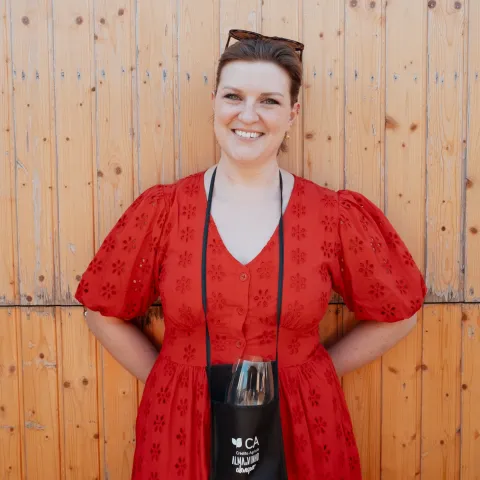
Madeleine, United Kingdom
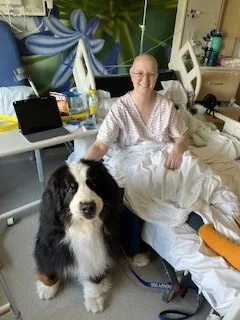
My cancer, Osteosarcoma, is very aggressive. Because it is a primary bone cancer, my first and main symptom was pain. At first I thought I had a ligament tear, but the pain didn't go away with rest and was worse at night. I didn't realise quite how serious that type of pain could be, especially that pain being worse at night is a serious red flag. I also had tonsilitis twice in 3 months, which was very unusual for me, as I'd only had it once before in my life!
When the pain was lingering after a month, I went to a physio. They recommended an MRI and a 5cm long tumour was found inside my thigh bone. I then had a biopsy, which confirmed that I had cancer.
It was only 4 months between the pain starting and my cancer diagnosis. By the time I was diagnosed, the tumour was 9cm long. If I had not had access to care from a physio and a private MRI scan and biopsy, I could be in a very different position. Others on my ward had amputations, but I was able to have limb sparing surgery as well as 18 rounds of inpatient chemotherapy.
The diagnosis ripped my world apart. I was 32 years old and I had never considered that I could be facing cancer at that age. I was in complete shock and by the time I started to understand what was happening to me, I was already in chemo.
Before the pain that led to my diagnosis, I was a body doing. I walked, I swam, I weightlifted. I existed in my own life, as I chose to. Then, only over a few weeks, every step I took became agony. Even before my diagnosis I could no longer use stairs.
Suddenly, between the pain, the morphine and the chemotherapy, I no longer felt like a person. My chemo was especially brutal - 18 rounds of in-patient chemo that around 2/3 of patients are unable to complete, because it is so damaging. I could not sit up. I could not get myself food or water. Every head turn and breath was costly. I lay completely still for hours and days and my body was nothing more than a heavy object I endured dragging around. It is hard to overstate how completely incapacitated I was.
My limb-sparing surgery was also very difficult to come to terms with. I have a large scar and a titanium knee and thigh bone prosthetic. Around 2/3 of my right leg is either fully titanium or contains some titanium. My body will never be the same again. I can never run again, or go to a HIIT class, or bend my knee fully. I will need the surgery every 15 years or so for the rest of my life, and each surgery will involve the same lengthy healing, pain and the frustration of learning to walk again.
The physical treatment was so extreme, that I did not even begin to grapple with how I was feeling until long after my treatment ended. There is just so much to manage as a cancer patient, and as a (relatively) young patient with a very rare cancer, I felt so isolated. My friends were planning weddings and having children while I was lying in agony unable to walk even a few metres. It is hard to put the feelings that cancer ignites into words.
As well as trying to understand how I felt about my own cancer, I also experienced cancer ghosting. This is very common, but is very painful. Cancer ghosting is where a loved one restricts or cuts off contact after a cancer diagnosis. It is devastating and baffling and I have lost really important friendships because I was diagnosed with cancer. It has completely shattered my heart.
Cancer truly does have a huge impact on every area of someone's life. I did not realise quite how ongoing the side effects would be. I am still unable to work full time a year after finishing chemotherapy and expect to be wrangling with my various disabilities for some time. After treatment can be just as challenging as during treatment for many cancer patients. You are still so unwell, but are expected to snap back to 'normal' and pick up your life exactly where it was before. I don't even know if I now want the same things as I did before my diagnosis. It is a very long journey and I still feel as though I am just at the beginning.
My brothers and my friends carried me through chemo.
I was not allowed to stay alone when I had my inpatient treatment. The hospital had an arrangement with a specialist hotel next door. I could stay next to the hospital, while being spared sleeping on a ward 3 weeks out of 5. This was a very good thing!! However, I was not allowed to stay in the chemo hotel alone. My friends and brothers set up a roster, so that I could have support through treatment. I am so endlessly grateful for their love and care. I am usually known for my independence, but I very literally could not have done this without the support of so many brilliant humans.
I was also so lucky to have a supportive team and employer. It meant the world during treatment and alleviated a lot of financial worries, but it has been especially incredible as I am phasing back into my working life.
I also decided on the day of my diagnosis that I was not going to doubt myself. I never allowed myself to believe I could not get through treatment. I treated my cancer as a Bad Thing. Bad Things happen to a lot of people across a lifetime, and some people are lucky while others are unlucky. I could do very little about my (quite dreadful) luck, but I could change how I approached it and influence how I felt about it. I resolved to approach my life day by day. Every day I woke up and asked myself what was available for me on that day. It would vary hugely, but I approached myself with care rather than shame or frustration. It helped me immensely.
I had a wonderful experience of healthcare. Although my initial appointments were private, my treatment was provided by the NHS. I am so endlessly proud to live in a country where healthcare is universal and free.
Because only around 150 people a year are diagnosed with Osteosarcoma in the UK, I was treated at a specialist centre in London. I am lucky to live in London and was able to travel to and from the hospital using Ubers. I received absolutely exceptional care. I am so grateful for the nurses, doctors, physios and support staff who supported me and took care of me across my lengthy treatments.
I still have scans every 8 weeks and will have scans for years. Although it can be nerve wracking, I am also grateful to be closely monitored.
I would say that you have more strength than you are aware of and you will be able to face this. Try and treat yourself with compassion and talk to yourself as if you are talking to a very dear friend or partner. Try to take things day by day.
Ask for help and accept it. There is so much available, especially in hospital and from the charity sector. Some people may not understand your new reality and that is ok. There are whole communities of cancer patients that will. Cancer is the worst way to meet the best people.