


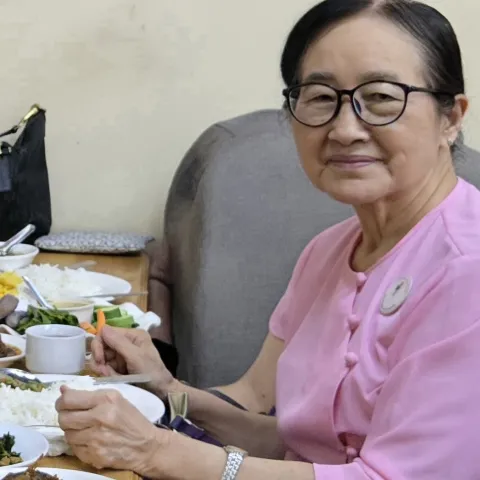
Mi, Myanmar
Today, January 14, 2026, marked the 38th memorial day for my late father. He had been a chronic chain smoker since he was 10 years old. At the age of 67, he started to cough up blood-stained sputum, became tired, and had chest pain. He consulted a chest physician, and after the necessary tests, he was diagnosed with lung cancer.
The biggest challenge was that I panicked and didn't know how to disclose the diagnosis to my mother first.
My parents live in a small town and weren't familiar with the term "cancer" at that time. My siblings and I decided to hide the diagnosis, fearing not only for the patient but also that my mother would have an emotional breakdown.
The oncologist's compassionate advice and counseling made my father accept radiation and chemotherapy, which we thought he might not.
Our family acted as the primary decision-maker, with a well-intentioned, loving effort to shield my vulnerable father. I requested the attending physician, and he complied with our requests. After six months of treat-ment, we lost him.
Now, after 38 years, I realize that our traditional cultural taboo against revealing a terminal diagnosis, once widely viewed as a "death sentence," is shifting toward more open, patient-centered communication.
Modern approaches emphasize that knowing a prognosis does not preclude hope; rather, it allows patients to prepare mentally, spiritually, and practically for the end of life. Education for the family or community is very crucial for redefining hope.
This story was published with the consent of Shwe Young Hnin Si Cancer Foundation, Myanmar.