


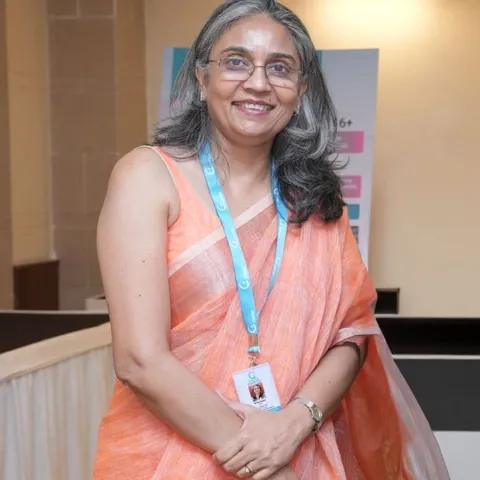
Mridu Gupta, India
My mother was diagnosed with lung cancer, and I lost her a year after the diagnosis. I was her primary caregiver in 2013.
When I look back, there were so many challenges and emotions. Until the time she was diagnosed, I had never really read about cancer or tried to understand it. I had no real knowledge. Once she was diagnosed, I started reading and learning, and that’s when I realised there were so many symptoms she must have had for a long time. I had noticed them, but I didn’t know they were signs of cancer, so we never got her checked.
It began with a cough. That was the only thing we recognised. She was treated for the cough, and based on the X-ray, she was diagnosed with TB. She remained on TB treatment for almost six months. Later, when her condition worsened and she developed severe diarrhoea, we went back to the hospital. That’s when we were told it was lung cancer.
This delay in diagnosis created a lot of distrust in the healthcare system. You start questioning everything. You wonder whether this diagnosis is even correct, or whether this could also be wrong. It took us a long time to accept the treatment that was being offered. That period of confusion and mistrust was one of the biggest challenges for us.
After I lost my mother, we started CAPED, the Cancer Awareness, Prevention and Early Detection Trust. What we realised very quickly was that awareness around pre-cancer, cancer prevention, early diagnosis, and available tests is extremely important. This information is not just for families affected by cancer. Everyone needs to know what to look for and what to do next.
We started CAPED along with others who had also lost their loved ones to cancer. When we spoke to medical professionals and took their guidance, many of them suggested focusing on cervical cancer, because from a prevention point of view, it is one cancer that can actually be prevented.
So in 2014, when we set up CAPED, our goal became to work towards a cervical cancer–free India. At that time, there was almost no awareness. People were not talking about it, there were no clear national guidelines, and even the medical community was largely silent on the issue. India, as a country, was simply unaware.
That itself became our motivation. If people don’t know and even professionals aren’t talking about it, then how will the message ever reach those who need it most?
I strongly feel that the healthcare system needs to start talking about cancer prevention and early detection. And this should not be limited to gynecologists or oncologists. Every doctor needs to be aware. Recently, a friend of mine had diarrhoea for a very long time. She was treated with one course of antibiotics after another. Eventually, when she went for a CT scan, she was diagnosed with ovarian cancer.
General physicians are often not trained to recognise early cancer symptoms. That’s exactly what happened with my mother. Because she had a cough, TB was the first assumption, and treatment started accordingly. When cancer treatment is delayed like this, it can become life-threatening. Early detection is completely missed.
This is why every doctor, whether they are a general physician, dentist, or any other specialist, should know the early symptoms of cancer and understand when further investigation is needed. Cancer awareness needs to become part of every healthcare interaction.
Doctors routinely ask about diabetes or blood sugar levels, even during dental visits, because they know it impacts treatment. Cancer should be treated the same way. There should be basic questions and red flags that doctors look for everywhere.
From a caregiver’s perspective, one of the biggest challenges is that when someone in the family is diagnosed with cancer, nobody knows where to go or what to do. Even today in India, caregivers are completely lost. I struggled too, because I didn’t know that support was something I could actively look for.
The first step is to reach out and ask for help. There is nothing wrong in saying that you need support. Whether it is from family, friends, or professionals, we cannot do this alone. We are not meant to.
Creating a support system is extremely important. Even the doctor treating your family member might be able to connect you to someone who can help. Having spaces where caregivers can share their experiences and support each other really matters.
Cancer is a long and exhausting journey. It causes deep fatigue, not just for the patient, but also for the caregiver. In India, we still don’t have enough support structures, and palliative care is limited. Caregivers often keep going until they are completely exhausted.
Somewhere, we need to change that. And it begins with all of us supporting each other.