


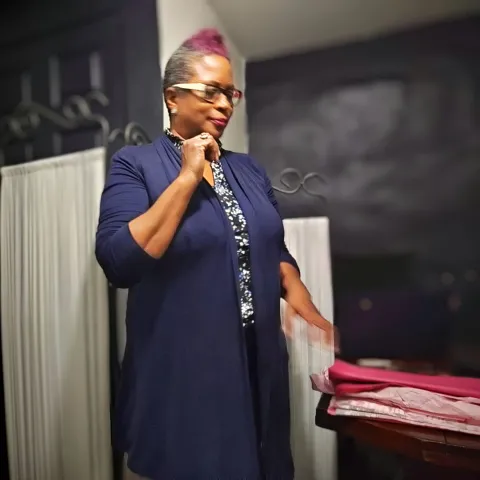
Nicole, Trinidad & Tobago
United by Unique: What Healing Looked Like in My Consultation Room This Week
Historically, survivorship is often discussed in broad, well-intentioned terms. Statistics. Milestones. Awareness campaigns.
Yet healing, the kind that reshapes daily life, often unfolds quietly in rooms most people never see.
This week, it unfolded in ours.
A woman returned for her review appointment, her first fitting since surgery, months earlier. Her initial visit was clinical and necessary.
This new appointment marked a new phase in her journey. Her body had changed, and came with a question she had not yet voiced aloud: How do I live comfortably in this body now?
Excited for this new phase which she anticipated and called in advance to confirm, she was also wearing a bra that no longer met her needs. A small detail, yet a very familiar one.
It is rarely about appearance. It is about readiness.
This visit represented a bold transition to everyday living. A quiet threshold, that requires intention, expertise and care.
She did not come alone.
She brought a friend. A sister as she referenced when she made warm introductions.
That sister had undergone a mastectomy in 2003.
She had been referred to us then. She knew about our work. Emotionally, she was not ready. Life continued. Time passed. She adapted quietly. She coped. She waited.
Until now.
Research shows that emotional readiness often follows a different path from physical recovery and the desire to return to normal life can delay efforts for many years.
Many women report postponing these services because the moment has not yet arrived.
When she entered the room, the atmosphere shifted. Laughter followed quickly, the kind that surfaces when guardedness begins to ease. We talked. We joked. We explored options. The mood became open and engaged. She was ready to dress with intention, to feel feminine, to reconnect with her body not as something defined by illness, but as something that remained her own.
Reconstruction, as many women discover, is not a conclusion. The body carries history and needs support, and thoughtful attention.
When I introduced a refined the fit, and showed her the many options, the response was immediate. Her body language shifted. Her expression softened. She paused as she looked at herself.
This was not vanity.
This was recognition.
She said quietly that she had not expected to feel this way.
In that moment, I was reminded of something fundamental about care: readiness is personal, and unfolds in its own time.
These two women received their diagnoses years apart. They arrived through different pathways. One was referred after surgery. The other carried awareness for many years before stepping into action.
They arrived together, on the same day, in the same space. United not by identical experiences, but by shared humanity.
This is what United by Unique looks like in practice.
It looks like care that honours time, whether measured in months or in decades.
It looks like meeting women where they are.
It looks like understanding the series of moments where comfort, confidence, and selfhood are reclaimed.
In my work, I witness the epitome of the theme #unitedbyunique in real time.
In conversation.
In body language.
In quiet moments when a woman recognises herself again.
Sometimes, that moment arrives after many years.