


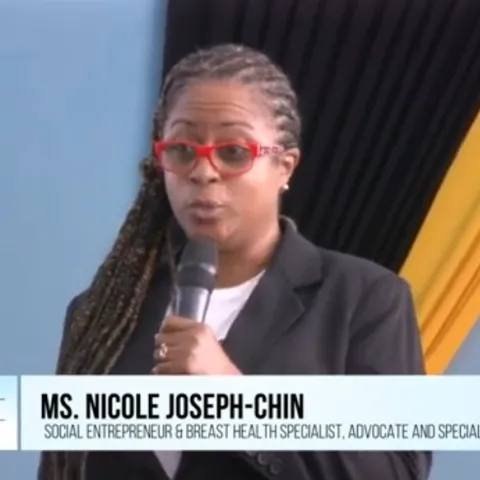
Nicole, Trinidad & Tobago

Post-Mastectomy Care in Motion
Breast cancer does not wait for the right moment.
Instead, it can enter life without reference to season, schedule, or circumstance, accompanied by an urgency that demands care.
It is carnival in Trinidad and Tobago and in many places around the world. A time when both care and chaos can coexist. Yet care has a rightful place because cancer does not wait, neither does it make any distinctions.
Moments like these also have the potential of collapsed certainty if not treated with an abundance of care and respect. What might have been already planned dissolves. What might have once felt peripheral becomes immediate. What might have been excitedly anticipated is now exchanged for immediacy.
In these instances, chaos never arrives gradually nor politely. It asserts itself and demands readiness. Any cancer diagnosis does not wait for the right moment, instead, it can enter life without reference to season, schedule, or circumstance, accompanied by an urgency that demands care.
Whenever an urgent call comes through for us just as a patient is being prepared for emergency mastectomy or lumpectomy surgery and requires our services, such moments sometimes remind us of just how the suspension of time requires the performance of dexterity and diligence, in addition to our expertise and experience. Care cannot be a casual afterthought or a considered alternative.
Nothing dislodges composure more quickly than a woman who is overwhelmed, confused and inundated with unfamiliar details. She can also err in the most important decisions about what she needs.
In such moments, response becomes our instinct, shaped by both our experience and our responsibility. Care moves first and fast but it also has an established contract around the responsibility we hold as Mastectomy Care Practitioners.
A role that is both nonjudgmental and weighted by the importance of the application of dignity.
In our category of patient centred care, what might otherwise be classified as anticipation must now be translated into assembly and advancement, not after arrival but in real time.
Care that arrives prepared affirms dignity before any conversations can begin, before uncalculated decisions are named aloud, before fear gets any further opportunities to take shape and before she purchases something that is not suitable.
Women often carry awareness of the collective sequence even when standing at the edge of any emergency and in a breast cancer diagnosis, it always translates to relief when preparation meets the person, not just the procedure.
Care is never singular, and it is rarely linear. It does not unfold in neat stages from diagnosis to intervention to recovery.
Instead, it emerges in overlapping moments, with simultaneous needs. In this instance, support assembled rather than arrived sequentially. A father, a husband, a best friend can all accompany the patient under our guidance.
Each will usually enter with a distinct role, a different language of care, a different contribution to stability.
Understanding the nonlinearity of care matters. Systems designed for orderly pathways often struggle to accommodate the lived reality of urgency, emotion, and adaptation.
When care is allowed to be non-linear, it becomes more responsive, more humane, and ultimately more effective. Care can flourish even in the most complex situations.
And even when care moves, shifts, and meanders beyond the clinical walls, life continues. Public rhythms on the outside mirror the scenes of carnival whilst the interior world of the woman might mirror rhythms of chaotic calm. Inside clinical spaces, time narrows into gowns, conversations, and preparation. These realities coexist.
Behind surgical gowns and beneath bras, women negotiate fear, identity, bodily change, and dignity. These negotiations are rarely visible, yet they are central to the experience of breast cancer care.
This is where care must be most innovative, intentional and intact. Present, purposeful and preserved.
In the contextual light of our work, it is not conditional about what is happening on the outside but about stopping to make the women who trust and rely on us, a high priority and make them at central focus of the world of care.
It is about being present for the patient, beyond readiness. It is about being the extended arm of care systems. It is about agility abounding compassion and empowering that patient when urgency arrives without invitation.
Care must be present, prepared, and capable, even when life continues at full speed.
About the author
Nicole Joseph-Chin is a women’s health educator and care systems practitioner whose work focuses on breast cancer care, post-mastectomy support, and dignity-centred health design. With decades of experience operating across clinical, community, and institutional settings, her work examines care as a structured discipline rather than a soft intervention, with particular attention to Global South contexts and people-centred cancer systems.