


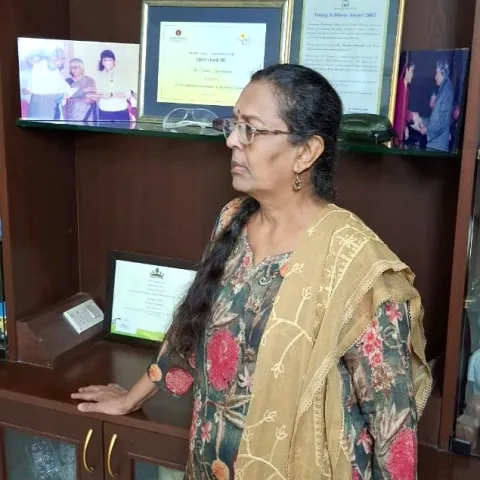
Swati, India
Cancer – Keep the Conversation Going
My cancer journey may have begun decades ago, in 1995, when I underwent a life-threatening surgery for a brain tumour on my auditory nerve. The operation saved my life but left one side of my face paralysed. The disease resurfaced unexpectedly in March–April 2025. In hindsight, the cancer cells had likely been active for months, but there were no clear warning signs.
January 2025 began with cataract surgery on my one good eye. I had lost vision in my right eye years earlier due to recurrent corneal ulcers following Bell’s palsy. My husband underwent cataract surgery soon after. By late 2024, I had begun to feel unusually fatigued and breathless while climbing even a short flight of stairs. I attributed this to fluctuations in my thyroid medication for hypothyroidism. Another symptom I overlooked was an intense craving for sweets. I had always had a sweet tooth, but after returning from the US in November 2024, my consumption increased significantly—even though we had reduced sugar elsewhere. An annual master health check-up in April 2024, including an abdominal ultrasound, had shown nothing abnormal.
In mid-March 2025, I noticed a clear fluid discharge while doing my morning exercises. It did not resemble an infection. When it recurred that evening, I became alarmed. As a medical journalist ( Pen name- Swati Amar), my instincts told me this was not normal. I tried self-medicating with an antifungal–antibiotic cream for a week. The discharge became regular—twice daily, minimal in quantity, with no blood—prompting me to use panty liners.
I consulted a uro-gynaecologist who, after several tests, diagnosed a urinary tract infection and prescribed antibiotics. She did not conduct an internal examination. When I questioned the connection between a UTI and uterine discharge, I was told it could be due to vaginal dryness common at my age (I am in my mid-sixties). I was unconvinced. After 15 days of antibiotics—changed midway—I independently opted for an abdominal ultrasound. It revealed abnormal growths in the uterus and ovary. Further tests, including CA-125 and MRI, confirmed endometrial cancer Stage IIIC with ovarian involvement at Stage I.
After extensive searching, we found an oncology surgeon. On May 2, 2025, I underwent a robotic vaginal hysterectomy with removal of ovaries and sentinel lymph node biopsy. The biopsy showed significant lymphovascular invasion, placing me in a high-risk category. This was followed by six cycles of chemotherapy, 25 radiation sessions with concurrent chemotherapy, and three brachytherapy sessions. To say the treatment was arduous would be an understatement.
But this story is not about me alone. It is about the millions of cancer patients in India and across the world who lack awareness of their condition, financial means, insurance coverage, emotional support, and access to timely treatment. It is about the myths, secrecy, and stigma surrounding cancer; the prolonged and painful treatment protocols—especially for children; the near-permanent side effects of medications; and the severe mental health toll on patients.
While several organisations and medical centres provide commendable care, far more needs to be done to address this scourge that debilitates vast numbers of productive citizens worldwide. There is an urgent need for concerted global efforts to promote faster, more effective, and affordable cancer treatments, particularly for paediatric cancers. Cancer medications should not cause devastating side effects such as irreversible organ damage or secondary cancers. Treatment costs must be drastically reduced and made free for low-income populations.
Governments and global health bodies must create an enabling and empowering ecosystem for cancer prevention, treatment, and care. They must also curb the stranglehold of pharmaceutical and med-tech industries that keep life-saving treatments exorbitantly priced and inaccessible. I appeal to the medical and scientific community to prioritise research that focuses on cure and affordability, rather than merely developing more potent therapies that often compromise patients’ quality of life by damaging healthy cells.
I also appeal to cancer patients who are informed and empowered to speak openly. A cancer diagnosis need not evoke fear. Conversations must be encouraged, lived experiences shared, and coping strategies exchanged. Social media and other platforms should foster support networks where patients stand together and speak as one—demanding free, safe, reliable care and authentic research aimed at a cure.
Because when human lives are at stake, nothing else matters.
Not money.
Not fame.
Every human being has a rightful place in this world—to live pain-free, disease-free, and productive. Toward this end, global health organisations must work relentlessly to ensure universal access to free healthcare for life-threatening and chronic illnesses that afflict millions.